
8-bit AVR microcontrollers are among the most popular microcontrollers used in embedded systems, hobby electronics, and automation projects. These microcontrollers provide a balance of simplicity, efficiency, and low power consumption, making them an excellent choice for beginners and experienced developers alike. AVR microcontrollers are great for building a DIY project, learning about embedded systems, and designing professional products.
In this guide, we explain what 8-bit AVR microcontrollers are, how they work, their history, and why they remain widely used today.
The History of 8-Bit AVR Microcontrollers
AVR microcontrollers were first developed in the 1990s by Atmel, a company known for its focus on embedded electronics. The goal was to create a microcontroller that was efficient, easy to program, and capable of executing instructions quickly. Atmel’s 8-bit AVR microcontrollers gained popularity due to their speed, reliability, and built-in features. In addition, these microcontrollers have built-in Flash program memory, SRAM, and many have built-in EEPROM for data storage.
In 2016, Microchip Technology acquired Atmel, integrating AVR microcontrollers into its product lineup. Since then, Microchip has continued to support 8-bit AVR microcontrollers, developing new tools and cross-platform development environments to enhance their usability.
What Is an 8-Bit AVR Microcontroller?
An 8-bit AVR microcontroller is a programmable integrated circuit designed to control electronic systems. The term “8-bit” means that the microcontroller processes data in 8-bit chunks, making it suitable for low-power applications, automation, and embedded systems.
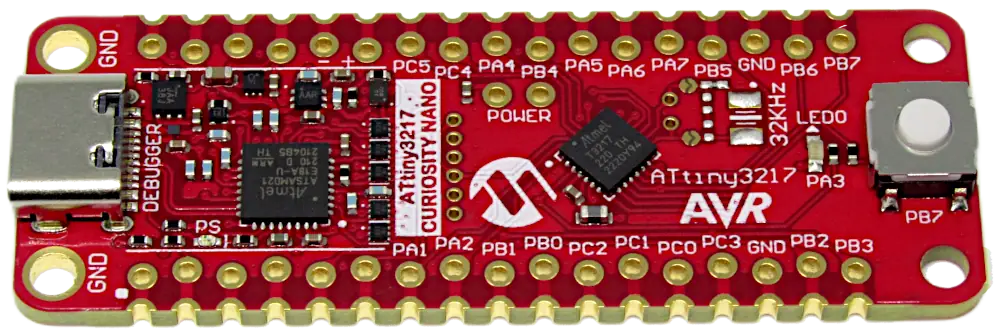
The image below shows an example of a modern 8-bit AVR microcontroller on an evaluation board. To the right of the center of the board is an ATtiny3217 microcontroller. It is the small black square chip oriented at a 45 degree angle. The big chip to the left side of the board is used to program the ATtiny3217 using a computer, via the USB port. See the related ATtiny3217 CNANO Tutorial and ATtiny3217 UART Tutorial.
Some of the key features of AVR microcontrollers that make them popular and useful are:
- RISC architecture for high-speed execution
- Low power consumption, making them ideal for battery-operated devices
- Built-in peripherals, such as timers, ADC, UART, SPI, and I2C
- Built-in memory, such as Flash, SRAM, and EEPROM
- Wide range of models with different memory sizes and capabilities
- Easy programming using C or Assembly
Why Are 8-Bit AVR Microcontrollers Still Popular?
Despite the availability of 32-bit microcontrollers, 8-bit AVR microcontrollers remain widely used due to their simplicity, affordability, and reliability. The following subsections discuss reasons as to why these devices are so popular.
1. 8-Bit AVR Microcontrollers Are Easy to Use
The architecture of 8-bit AVR microcontrollers is designed for simplicity, making them a great starting point for beginners. They have fewer registers and instructions compared to more complex microcontrollers, making them easier to learn and program.
2. Low Power Consumption
Many applications require microcontrollers that can operate efficiently on low power. AVR microcontrollers are optimized for minimal power usage, making them perfect for battery-operated devices and energy-efficient projects.
3. Cost-Effective
8-bit AVR microcontrollers are affordable, making them accessible for hobbyists, students, and engineers designing budget-friendly projects. Although there may be 32-bit microcontrollers that are very competitive on pricing, these devices are usually more expensive to place on a board in low quantities. 32-bit microcontrollers are usually surface mount devices, which means that a professionally made circuit board is needed in order to use them. 8-bit AVR microcontrollers in DIP packages can still be hand soldered to home-made boards, or prototype boards such as stripboard.
4. Strong Community Support
With decades of usage, AVR microcontrollers have a large community of users. This means extensive documentation, open-source projects, and support forums to help new developers get started.
5. Wide Operating Voltage Range
Many devices have a wide operating voltage range, depending on the part. For example an ATmega1284 part has the following voltage specification:
- Operating Voltages
- 1.8 – 5.5V
- Speed Grades
- 0 – 4MHz @ 1.8 – 5.5V
- 0 – 10MHz @ 2.7 – 5.5V
- 0 – 20MHz @ 4.5 – 5.5V
6. High Output Pin Strength
A pin on an 8-bit AVR microcontroller can typically deliver more than 20mA, which is much higher than most 32-bit ARM microcontrollers. In some circuits this high drive strength can eliminate the need for an additional external component, such as a transistor, which saves cost, board space, and inventory count.
7. Easy to Use Packages
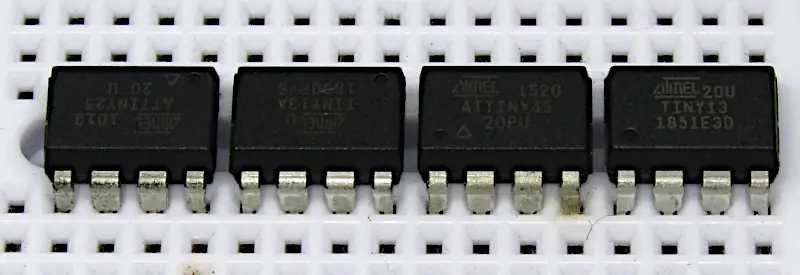
All 8-bit AVR devices are available in one or more different types of surface mount packages. Some devices are available in DIP packages that plug directly into electronic breadboards – ideal for hobby and breadboard prototyping.
Popular 8-Bit AVR Microcontrollers
There are many 8-bit AVR microcontrollers, each designed for different applications. Below are some of the most commonly used models.
ATmega328P: The Most Popular 8-Bit AVR Microcontroller
This microcontroller is used on Arduino Uno revision 3 and earlier Arduino Uno boards. See the UNO Family section on the Arduino Hardware website page for more information. Some features of the ATmega328P microcontroller are:
- Used in Arduino Uno (ATmega 328P) and other development boards
- 32 KB Flash memory, 2 KB RAM
- General-purpose microcontroller for electronics projects
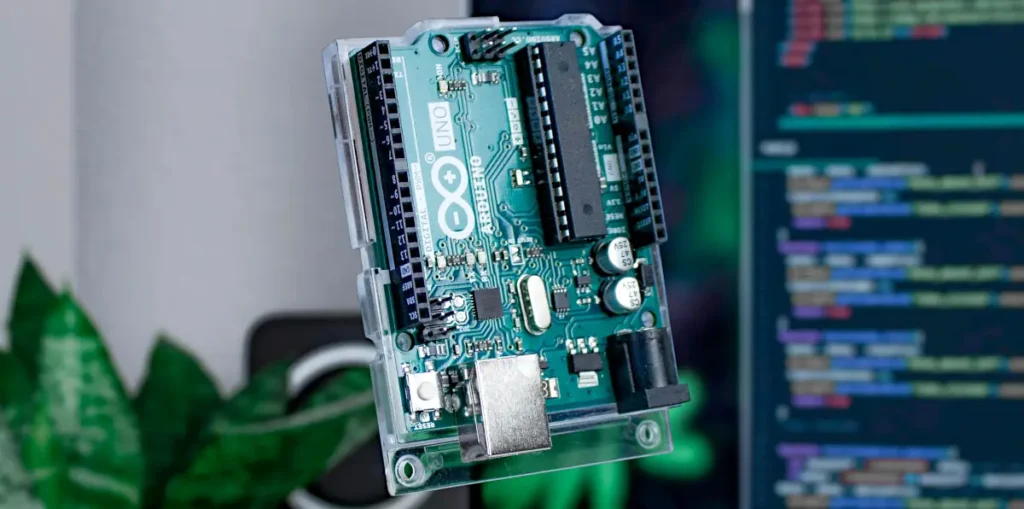
ATmega 328P 8-bit AVR Microcontroller on an Arduino Uno Board
ATtiny85: A Compact 8-Bit AVR Microcontroller
The ATtiny85 is a compact yet powerful 8-bit AVR microcontroller that has become a favorite among hobbyists, makers, and even professionals working on space-constrained embedded projects.
- Small, low-power microcontroller
- 8 KB Flash memory, 512 Bytes RAM
- Ideal for miniaturized and battery-powered projects
ATmega2560: A High-Powered 8-Bit AVR Microcontroller
- Used in Arduino Mega 2560 board
- 256 KB Flash memory, 8 KB RAM
- Suitable for complex robotics and automation projects
ATmega328, ATmega128, ATmega8, ATmega1284 and ATmega32
Overall, some of the most popular AVR devices are the ATmega328, ATmega128, ATmega8, ATmega1284 and ATmega32, all from the ATmega range. The following list includes some details about these devices and links to information about them on the Microchip website.
- ATmega 328 – this was the Atmel ATmega328 used in the Arduino Uno, and is now the Microchip ATmega328. The ATmega 328P is this same device packaged in a plastic DIP (Dual In-line Package) which is the actual device used in the Arduino Uno that has a chip socket for it.
- ATmega 128 – the ATmega128’s popularity comes from its rich feature set, good balance of performance and cost, and ease of programming.
- ATmega 8 – a solid choice for small embedded systems, hobbyist projects, and simple controllers where the added complexity of a more powerful chip is not necessary.
- ATmega 1284 – available in a 40 pin DIP package which is ideal for hobby breadboard work.
- ATmega 32 – another device that is available in a 40 pin DIP package which is ideal for hobby breadboard work.
AVR Microcontroller Families
AVR microcontrollers from Atmel (now part of Microchip Technology) have evolved over time into several distinct families. Each family offers different features, pin counts, and performance levels to meet a wide variety of embedded applications.
From ultra-small ATtiny chips to powerful 32-bit UC3 devices, AVR MCUs are used by hobbyists and professionals alike. In this section, we explore the major AVR families still in use today, with a focus on the 8-bit AVR microcontrollers that this website is all about. The table below summarizes the AVR microcontroller families with more details after the table.
| Family | Architecture | Details |
|---|---|---|
| ATtiny | 8-bit | Lower pin count, smaller memories, include older and more recent variants |
| ATmega | 8-bit | More pins, generally more memory than the ATtiny series, include older and more recent variants |
| AVR Dx / AVR xx | 8-bit | New generation of AVR microcontrollers |
| XMEGA | 8-bit | Advanced features, higher pin count, bigger memories |
| UC3 | 32-bit | 32-bit architecture that is not related to the 8-bit AVR architecture, higher performance with larger memories |
| AT90S | 8-bit | Earlier AVR microcontrollers, most devices are now obsolete |
8-bit AVR Families
The AVR8 architecture is known for its simplicity, speed, and efficiency. These microcontrollers are ideal for embedded systems where performance, power consumption, and ease of use are critical. On this website, we focus on 8-bit AVR microcontrollers because they are beginner-friendly, well-supported by the community, and widely used in hobbyist and commercial projects.
Below are the major 8-bit AVR families you’ll encounter today, namely, the ATtiny, ATmega, AVRxx, and ATxmega series.
ATtiny Series of 8-bit AVR Microcontrollers
The ATtiny family features compact, low-power microcontrollers designed for small, resource-constrained projects. With fewer I/O pins and limited memory, ATtiny chips are perfect for applications like wearables, sensors, and small automation devices. They often come in small packages like SOIC or DIP, making them ideal for breadboarding and DIY projects.
Most modern ATtiny devices now use the UPDI programming interface, replacing the older ISP and High Voltage programming methods. The latest ATtiny microcontrollers are organized into sub-families, ATtiny 0-, 1-, and 2-series, which add new features like improved peripherals, event systems, and more memory options.
Popular models include the the older ISP programmable ATtiny85, and the ATtiny1616, as well as the modern ATtiny202 from the new series of UPDI programmable devices.
ATmega Series of 8-bit AVR Microcontrollers
The ATmega family is perhaps the most well-known 8-bit AVR series, widely adopted by the Arduino community. These microcontrollers offer a balance of power and features, with more flash memory, SRAM, and I/O than their ATtiny counterparts.
Devices like the ATmega328P (used in Arduino Uno) and ATmega2560 (used in Arduino Mega) are popular choices for more advanced hobbyist and professional projects. Most ATmega chips are programmed using the AVR ISP protocol, with some older chips supporting debugWIRE for debugging.
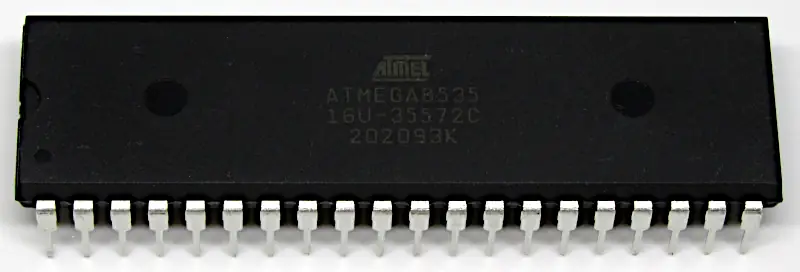
The image below shows an ATmega8535, which is a 40-pin DIP 8-bit AVR microcontroller from from the older ATmega series.
Microchip has also introduced modernized ATmega 0-series devices that include improved peripheral sets and use the UPDI programming interface instead of traditional ISP. These newer devices offer a more robust feature set while maintaining backward compatibility with existing tools and codebases.
AVR Dx / AVR xx Series of 8-bit AVR Microcontrollers
The AVR Dx / AVR xx series represents the new generation of 8-bit AVR microcontrollers. These chips bring modern features such as configurable custom logic, event systems, improved peripherals, and enhanced CPU performance, all while remaining true to the AVR8 architecture. They use the Unified Program and Debug Interface (UPDI) for programming and debugging, eliminating the need for separate interfaces.
The AVR xx lineup includes multiple sub-families:
- AVR DA: Functional Safety Ready Family of Microcontrollers for Real-Time Control, Connectivity and HMI Applications
- AVR DB: Designed for Demanding Analog Applications
- AVR DD: Designed for Multi-Voltage Analog Applications
- AVR DU: Adds USB support for device connectivity
- AVR EA: Advanced Analog Sensing
- AVR SD: Low-Cost ASIL C/SIL 2-Compliant
- AVR EB: for Motor Control and Analog Sensing
Examples include the AVR128DA48, AVR64DD32, and AVR16EB32. These families are well-suited for both entry-level and advanced embedded projects, offering impressive capabilities in compact packages and with long-term availability.
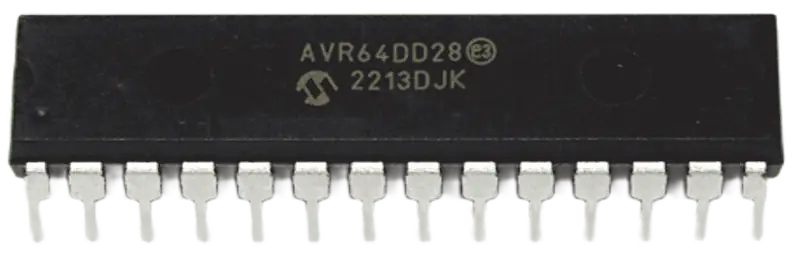
Some devices in this new series are available in DIP packages, which Microchip calls SPDIP (Skinny Plastic Dual In-Line), which is good news for hobbyists as they fit directly on a standard electronic breadboard. An example is the AVR64DD28 shown in the image below.
XMEGA Series of 8-bit AVR Microcontrollers
The ATxmega family sits between the ATmega and 32-bit UC3 families in terms of performance. These microcontrollers offer features like DMA, event systems, advanced timers, and more communication peripherals. They are ideal for applications that require more processing power and functionality than the ATmega series but still want to stay within the 8-bit realm.
Devices like the ATxmega128A1U are still in production and supported by Microchip. XMEGA chips typically use the PDI interface for programming and JTAG or debugWIRE for debugging.
32-bit AVR Family: UC3 Series
The AVR UC3 family consists of 32-bit microcontrollers based on the AVR32 architecture, which is significantly different from the 8-bit AVR core. These chips offer high performance, advanced peripheral sets, and are suited for more demanding applications like audio processing, USB host/device support, and real-time control.
Although not as popular in the hobbyist world, UC3 devices like the AT32UC3A1512 are still in production and available from Microchip and distributors like DigiKey. However, they are not compatible with 8-bit AVR tools and require a different development approach. For most users interested in classic AVR development, the 8-bit families remain the best choice.
Obsolete Classic 8-bit AVR Microcontrollers
Before the current families took shape, Atmel introduced some early AVR microcontrollers such as the AT90S1200, AT90S2313, and AT90S8515. These classic devices laid the foundation for the AVR architecture but lacked many of the features and refinements of modern chips.
Today, these early AVRs are considered obsolete and have been replaced by newer ATtiny and ATmega models that offer better performance, lower power consumption, and more memory. While you might still find references to these chips in older tutorials or legacy designs, it’s best to use their modern replacements for new projects.
Getting Started with 8-Bit AVR Microcontrollers
To begin working with 8-bit AVR microcontrollers, you need a development environment for writing and uploading programs. Here are some of the best tools available today:
1. Arduino IDE
The Arduino IDE is one of the easiest ways to program AVR microcontrollers, especially for hobbyists and beginners. It supports a wide range of AVR-based boards, including the Arduino Uno and Arduino Mega.
2. Microchip Studio for Windows (No Longer Updated)
Microchip Studio, previously known as Atmel Studio: this Windows-based IDE was designed for AVR and ARM microcontrollers originally from Atmel. While still functional, Microchip has stopped updating this tool, encouraging developers to switch to newer cross-platform alternatives.
3. Microchip’s New Cross-Platform Tools
Microchip now provides cross-platform development tools that run on Windows, macOS, and Linux, making AVR development more accessible:
- MPLAB X IDE – A professional development environment for 8-bit AVR microcontrollers and other microcontrollers from Microchip
- AVR-GCC and AVRDUDE – Open-source tools for compiling and programming AVR chips
- Microchip MPLAB Code Configurator (MCC) – A graphical tool for setting up peripherals and generating code for AVR microcontrollers
- MPLAB for VS Code – the full Microchip toolchain inside the world’s most popular code editor (Visual Studio Code editor).
Using these tools, developers can now work with 8-bit AVR microcontrollers on any operating system. See the related articles:
- How to Install MPLAB X IDE for AVR Development
- Easily Create Your First MPLAB Project: Step-by-Step Guide
Are 8-Bit AVR Microcontrollers Still a Good Choice?
Despite the rise of more powerful 32-bit alternatives, 8-bit AVR microcontrollers remain widely used for:
- Learning embedded systems
- Low-power applications
- Budget-friendly projects
Their simplicity, efficiency, and strong community support make them an excellent choice for both beginners and professionals. Remember that the cost of a microcontroller is only part of the cost of a project. It is necessary to factor in assembly and build costs. For example it is easier to build an AVR microcontroller project on a prototype board using DIP devices than to use surface mount devices. Also consider that there are a large number of open-source AVR boards available off the shelf that can easily be used in many projects.
How 8-Bit AVR Microcontrollers Work
An 8-bit AVR microcontroller is a complete computer system contained within a single integrated circuit. Unlike a desktop computer, which requires separate components for the processor, memory, and input/output hardware, an AVR microcontroller combines these functions on one chip. This makes it possible to build relatively simple electronic systems with very few external components. Of course the 8-bit AVR has a fraction of the computing power of a modern desktop PC. These devices are more suitable for simpler dedicated embedded applications, rather than for general purpose computing.
At the center of an 8-bit AVR microcontroller is the AVR CPU. The CPU executes instructions stored in the device’s program memory, performs calculations, and controls the other hardware inside the microcontroller. The program determines how the microcontroller responds to inputs and controls its outputs.
For example, a simple AVR project could monitor a push button connected to an input pin. When the button is pressed, the program could detect the change in the input and turn an LED connected to an output pin on or off. The CPU performs the processing, while the microcontroller’s input/output hardware provides the connection between the program and the external circuit.
The AVR CPU
The CPU, or Central Processing Unit, is responsible for executing the instructions that make up the microcontroller program. An AVR CPU contains registers and an arithmetic logic unit (ALU) that allow it to perform operations on data.
When an AVR program is running, the CPU repeatedly fetches instructions from program memory, decodes them, and executes them. Depending on the instruction, the CPU may perform an arithmetic operation, move data between registers, read an input, change an output, or control the flow of the program. When programming in a higher level language such as C, the details of the register are hidden from the programmer.
The AVR architecture is based on a RISC, or Reduced Instruction Set Computer, design. The instruction set contains relatively simple instructions that can be executed efficiently. This contributes to the AVR architecture’s combination of performance and relatively simple programming model.
Program Memory
The program executed by an AVR microcontroller is stored in its Flash memory. Flash memory is non-volatile, meaning that its contents remain stored when the power is removed. In addition, Flash memory can be erased and reprogrammed with new or updated software.
When a program is compiled, the compiler converts the source code into machine instructions that the AVR CPU can execute. These instructions are then programmed into the microcontroller’s Flash memory.
The amount of Flash memory varies between AVR devices. Small ATtiny microcontrollers may have only a few kilobytes of Flash, while larger ATmega and modern AVR devices can provide considerably more.
Data Memory
An AVR microcontroller also requires memory for data used while a program is running. SRAM, or Static Random Access Memory, is used for variables, temporary data, and the program stack. Unlike Flash memory, SRAM is volatile. Its contents are lost when the microcontroller’s power is removed.
The amount of SRAM is therefore an important specification when selecting an AVR microcontroller. A simple program controlling a few LEDs may require very little RAM, while an application that processes sensor data or communicates with several peripherals may require considerably more.
Input and Output
One of the most important functions of a microcontroller is connecting the program running inside the chip to the external electronic circuit. AVR microcontrollers provide this through general-purpose input/output pins, commonly called GPIO.
An I/O pin can generally be configured as an input or an output. An input can be used to detect the state of a switch or read a digital signal from another device. An output can be used to control an LED, transistor, relay driver, or other external circuit. The exact number and capabilities of the I/O pins depend on the AVR model.
Built-In Peripherals
An AVR microcontroller contains much more than a CPU and memory. Depending on the device, it can include hardware peripherals that perform common functions without requiring the CPU to handle every operation directly.
Common AVR peripherals include:
- Timers and counters
- PWM outputs (Pulse Width Modulation)
- Analog-to-digital converters
- UART serial communication
- SPI communication
- I2C communication
- Analog comparators
- Interrupt controllers
Modern AVR devices can also include more advanced peripherals such as configurable logic and event systems.
For example, a timer can generate a precisely timed event without the program having to continuously count instructions. Similarly, an ADC can convert an analog voltage into a digital value that the program can process.
The Clock
The AVR CPU operates according to a clock signal. The clock provides the timing reference that determines when processor operations take place.
The clock frequency is normally specified in megahertz (MHz). A higher clock frequency allows the CPU to execute instructions more rapidly, although clock frequency alone does not determine the overall performance of a microcontroller.
Different AVR devices provide different clock options. Depending on the device, the clock can be provided by an internal oscillator or an external clock source or crystal.
Interrupts
AVR microcontrollers can respond to events using interrupts. An interrupt allows a peripheral or external signal to temporarily interrupt the normal flow of the program so that the CPU can execute a special interrupt service routine.
For example, an external input could generate an interrupt when a button is pressed, or a timer could generate an interrupt at regular intervals. The CPU can then execute the appropriate code to respond to the event.
Interrupts are particularly useful when a microcontroller needs to respond to events while also performing other tasks.
A Simple Example
Consider an AVR microcontroller controlling an LED and monitoring a push button.
The program could perform the following sequence:
- Configure one I/O pin as an input for the push button.
- Configure another I/O pin as an output for the LED.
- Read the state of the button.
- Determine whether the button is pressed.
- Set the LED output accordingly.
- Repeat the process continuously.
Although this is a simple example, the same basic principle applies to much more complex embedded systems. The program running on the CPU reads inputs, processes information, and controls outputs while using the microcontroller’s built-in peripherals to perform specialized tasks.
The advantage of an 8-bit AVR microcontroller is that the CPU, memory, I/O, timers, communication interfaces, and other hardware are integrated into a single device. This allows a complete electronic control system to be built using a relatively small amount of hardware.
8-Bit AVR Microcontroller Architecture
Understanding the architecture of an 8-bit AVR microcontroller makes it easier to understand how AVR programs interact with the hardware. Although individual AVR devices differ in their memory sizes, peripherals, pin counts, and other features, they share many fundamental architectural concepts.
The AVR architecture combines an 8-bit RISC CPU with program memory, data memory, registers, I/O ports, and hardware peripherals. The exact implementation varies between AVR families, particularly between older AVR devices and newer generations, but the basic principles remain similar.
RISC Architecture
AVR microcontrollers use a RISC, or Reduced Instruction Set Computer, architecture. RISC processors use a relatively compact set of instructions designed to perform fundamental operations efficiently.
The AVR instruction set includes instructions for operations such as moving data, performing arithmetic and logical operations, accessing memory, changing I/O states, and controlling program execution.
The AVR architecture also provides a set of general-purpose registers that can be used directly by many instructions. This allows programs to perform operations on data efficiently without constantly accessing slower memory locations.
AVR Registers
Registers are small, fast storage locations located within the CPU. They are used to hold data that the processor is currently working with.
Classic AVR devices provide 32 general-purpose 8-bit registers, named R0 through R31. These registers are an important part of the AVR architecture and are used extensively by AVR assembly language instructions and by compiled C programs.
Some of the registers can also be used together as 16-bit register pairs for operations involving memory addresses or other 16-bit values.
In addition to the general-purpose registers, AVR microcontrollers contain special-purpose registers associated with the CPU, I/O system, and peripherals.
Status Register
The Status Register, commonly called SREG, contains flags that indicate the result of certain CPU operations.
For example, arithmetic operations can set flags indicating whether the result was zero, whether a carry occurred, or whether the result was negative. Program instructions can use these flags when making decisions or controlling program flow.
Understanding the status register is particularly useful when learning AVR assembly language because many conditional instructions operate based on the status flags.
Program Counter
The Program Counter keeps track of the location of the next instruction to be executed. As the AVR CPU executes a program, the Program Counter normally advances through the instructions stored in program memory. Branches, jumps, calls, interrupts, and returns can change the normal sequence of execution.
Stack and Stack Pointer
The stack is an area of memory used for temporary storage while a program is running. It is commonly used when functions are called and when interrupts occur.
The Stack Pointer keeps track of the current location of the stack in memory.
The stack is also important when writing C programs because function calls and local variables can require stack memory. For this reason, the amount of available SRAM is an important consideration when choosing an AVR microcontroller.
Harvard Architecture
AVR microcontrollers use a modified Harvard architecture in which program memory and data memory are separate.
Program instructions are stored in Flash memory, while variables and other runtime data are stored in data memory. This arrangement allows the CPU to access program instructions and data using separate memory paths.
The distinction is important when programming AVR devices because Flash memory and SRAM have different purposes and different methods of access.
Flash Memory
Flash memory stores the program that the microcontroller executes. It is non-volatile, so the program remains stored when the power is removed.
The amount of Flash memory is an important specification when selecting an AVR. A small program for a simple control application may require only a few kilobytes, while a more complex application may require substantially more program memory.
SRAM
SRAM provides temporary storage while the program is running. It is used for variables, buffers, the stack, and other temporary data. SRAM is volatile, so its contents are lost when power is removed.
The amount of SRAM can become a significant limitation in applications that process large amounts of data. A microcontroller with sufficient Flash memory may still be unsuitable for an application if it does not have enough SRAM.
EEPROM and Non-Volatile Data
Many AVR microcontrollers also provide EEPROM or another form of non-volatile data storage. EEPROM can be used to store information that must survive a power cycle.
For example, a program could store a calibration value, configuration setting, or user preference in non-volatile memory. The exact memory types and capacities vary between AVR devices, so the datasheet for the particular device should always be checked.
I/O Registers and Peripheral Registers
The CPU communicates with the microcontroller’s I/O ports and peripherals through registers. For example, registers associated with a GPIO port can be used to configure whether pins are inputs or outputs and to read or control their digital states.
Similarly, timer, ADC, UART, SPI, and other peripheral registers allow the program to configure and control those peripherals.
This register-based approach is one reason that understanding the AVR architecture is useful when moving beyond high-level Arduino programming into direct AVR C or assembly language programming.
Peripherals and the CPU
Hardware peripherals perform many common tasks independently of the CPU. A timer, for example, can count clock cycles while the CPU executes other instructions.
Peripherals can also communicate with the CPU using interrupts. A timer could generate an interrupt when a specified count is reached, allowing the program to respond to the event without continuously checking the timer.
Modern AVR microcontrollers can go further by allowing some peripherals to communicate with one another through event systems. This can reduce the amount of CPU processing required for certain applications.
Understanding the AVR Architecture
The architecture can therefore be viewed as several interconnected parts:
- CPU: Executes the program instructions.
- Registers: Provide fast storage for data and CPU operations.
- Flash memory: Stores the program.
- SRAM: Stores variables and temporary data.
- EEPROM or other non-volatile memory: Stores data that must survive power removal, when provided.
- I/O ports: Connect the CPU and peripherals to external circuits.
- Peripherals: Provide hardware functions such as timers, ADC, PWM, and communication interfaces.
- Clock system: Provides the timing required for CPU and peripheral operation.
The exact architecture and peripheral set varies between AVR families. Consequently, understanding the general AVR architecture is useful, but the datasheet and device documentation remain essential when developing a circuit around a specific AVR microcontroller.
Choosing an 8-Bit AVR Microcontroller
There are many 8-bit AVR microcontrollers available, ranging from very small devices with only a few pins to larger devices with substantial amounts of memory and numerous peripherals. Choosing the right device therefore requires more than simply selecting the AVR with the largest memory capacity or highest clock speed.
The best 8-bit AVR microcontroller is the one that provides the required features without unnecessary cost, complexity, or power consumption. The following factors should be considered when selecting an AVR for a project.
Number of I/O Pins
The first consideration is often the number of input and output pins required by the application.
A simple project controlling a few LEDs may need only a handful of I/O pins, making a small ATtiny device suitable. A project with multiple switches, sensors, displays, motors, and communication interfaces may require considerably more pins.
Remember that some pins may have multiple functions. A pin used as a general-purpose digital I/O pin may also provide an ADC input, timer output, or communication signal. The datasheet and pinout should therefore be checked carefully to determine how many usable pins are actually available for the application.
Flash Memory
Flash memory stores the program executed by the AVR microcontroller.
A simple application may require only a small amount of Flash memory, while a larger program containing multiple libraries, communication functions, display drivers, and other features may require considerably more.
It is generally better to estimate the required program size rather than automatically selecting a device with the largest available memory. However, allowing some additional space for future software changes can be useful.
SRAM
SRAM is used for variables, buffers, the stack, and other temporary data while the program is running.
SRAM requirements can increase considerably when an application processes sensor data, communicates with external devices, or uses displays and communication buffers. A device with sufficient Flash memory may still be unsuitable if it has insufficient SRAM.
For this reason, both Flash and SRAM should be considered when comparing AVR microcontrollers.
Non-Volatile Data Memory
If the project needs to store settings or other information when the power is removed, check whether the AVR provides suitable non-volatile memory.
EEPROM has traditionally been used in many AVR devices for storing small amounts of persistent data. Modern AVR devices can provide different memory arrangements, so the datasheet should be consulted to determine what non-volatile memory is available and how it can be used.
Examples of information that might need to be stored include calibration constants, configuration settings, counters, and user preferences.
Operating Voltage
The supply voltage is an important consideration because the AVR must be compatible with the power supply used by the circuit.
Some AVR microcontrollers can operate over a relatively wide voltage range, while others have more specific voltage requirements. The maximum clock frequency can also depend on the supply voltage.
When selecting a device, check both the operating voltage range and the maximum operating frequency at the intended supply voltage. Do not assume that an AVR can operate at its highest specified clock frequency at every possible supply voltage.
Clock Speed
The clock frequency determines how quickly the AVR CPU operates. A higher clock frequency can provide more processing capability, but it can also increase power consumption.
Many embedded applications do not require the highest possible clock speed. A lower clock frequency may be entirely adequate for monitoring switches, controlling LEDs, reading sensors, and performing other relatively simple tasks.
The required clock speed should therefore be determined from the application’s processing requirements rather than selected simply because it is the highest available value.
Timers and Counters
Timers and counters are among the most useful AVR peripherals. They can be used for generating accurate time intervals, measuring signals, generating PWM, and producing periodic interrupts.
If the application requires precise timing or PWM, check the number and type of timers available on the AVR. Different devices can have different timer architectures and capabilities.
Analog-to-Digital Converter
An ADC is required when the microcontroller needs to measure analog voltages. For example, an ADC can be used to measure a temperature sensor, potentiometer, battery voltage, light sensor, or other analog signal.
When selecting an AVR with an ADC, consider the number of analog inputs, ADC resolution, reference voltage options, conversion speed, and other relevant specifications.
Communication Interfaces
If the AVR needs to communicate with other integrated circuits or external equipment, check which communication interfaces are available.
Common interfaces include:
- UART: Useful for serial communication with computers, modules, and other microcontrollers.
- SPI: A fast synchronous interface commonly used with displays, memory devices, sensors, and other peripherals.
- I2C: A two-wire bus that allows multiple devices to share the same communication lines.
The number of available communication peripherals and their exact capabilities vary between AVR devices.
Package Type
The physical package can be particularly important during prototyping.
Some AVR microcontrollers are available in DIP packages that can be inserted directly into a breadboard or used on stripboard. Other devices are available only in surface-mount packages.
For a professionally manufactured PCB, a surface-mount package may be perfectly appropriate. For beginners and hobbyists building prototypes by hand, however, a DIP package can make construction considerably easier.
The package should therefore be considered alongside the electrical specifications rather than treated as an afterthought.
Programming and Debugging Interface
The programming interface must also be compatible with the tools available for the project.
Older and classic AVR microcontrollers commonly use ISP for programming. Many newer AVR devices use UPDI for programming and debugging. Other AVR families can use interfaces such as PDI or JTAG.
Choosing an AVR with an unfamiliar programming interface is not necessarily a problem, but the required programmer or debugger must be available before starting development.
Power Consumption
Power consumption is particularly important in battery-powered applications.
The current drawn by an AVR depends on factors such as supply voltage, clock frequency, peripheral activity, and whether the device is operating or sleeping. Datasheet specifications should therefore be examined under conditions that are representative of the intended application.
If the microcontroller spends much of its time waiting for an event, a device with suitable sleep modes may significantly reduce average power consumption.
Available Peripherals
Avoid selecting an AVR based only on its Flash, SRAM, and number of I/O pins. The peripherals can have an equally important effect on the suitability of a device.
For example, one AVR may have the required number of I/O pins but lack enough ADC channels. Another may have sufficient memory but not provide the timer or communication interface required by the application.
Make a list of the required peripherals before selecting the device, then compare that list with the features of candidate AVR microcontrollers.
Availability and Long-Term Support
The availability of a microcontroller should also be considered, particularly for a product that may be manufactured for many years.
A device that is inexpensive and technically suitable may not be the best choice if it is difficult to obtain. Check the manufacturer’s current product information and distribution channels before committing a new design to a particular device.
For a new design, it can also be worth considering a current AVR device rather than selecting an older device simply because it is familiar.
Choosing Between ATtiny, ATmega, and Modern AVR Devices
As a general starting point, an ATtiny can be a good choice for a small project with limited I/O and memory requirements. ATmega devices are often appropriate when more I/O, memory, or peripherals are required, particularly when working with established Arduino-based hardware and software.
Modern AVR devices provide another option for new designs. Depending on the family, they can offer more advanced analog functions, configurable logic, event systems, and other modern peripherals while retaining the 8-bit AVR architecture.
These categories are only a starting point, however. There is considerable variation between individual devices within each family.
Make a Requirements List Before Choosing
A practical way to select an 8-bit AVR microcontroller is to write down the requirements of the project before looking at specific part numbers.
For example, the list might include:
- Minimum number of I/O pins
- Required Flash memory
- Required SRAM
- Required non-volatile memory
- Supply voltage
- Required clock speed
- Number of ADC inputs
- Number and type of timers
- PWM requirements
- UART, SPI, or I2C requirements
- Required programming interface
- Maximum acceptable power consumption
- Preferred package
- Availability and cost
Once these requirements have been established, it becomes much easier to compare AVR devices and eliminate parts that do not meet the requirements.
Finally, always consult the manufacturer’s datasheet before selecting an AVR for a specific circuit. Specifications can differ significantly between individual 8-bit AVR microcontrollers, even when they belong to the same general family. The datasheet provides the information needed to determine whether a particular device is suitable for the intended application.
Frequently Asked Questions
What is an 8-bit AVR microcontroller?
An 8-bit AVR microcontroller is a programmable integrated circuit based on the AVR 8-bit processor architecture. It combines a CPU, memory, digital input/output, and peripheral hardware in a single chip. Depending on the model, peripherals can include timers, analog-to-digital converters, UART, SPI, I2C, PWM, and other interfaces.
The “8-bit” designation refers to the processor’s 8-bit architecture and its ability to efficiently process 8-bit data. AVR microcontrollers are used in embedded systems, electronics projects, automation, sensors, battery-powered devices, and many other applications.
What does 8-bit mean in an AVR microcontroller?
The 8-bit designation describes the width of the AVR processor architecture. The CPU is designed to efficiently perform operations on 8-bit values, although AVR microcontrollers can also work with larger values by using multiple instructions.
An 8-bit processor is not necessarily unsuitable for more demanding applications. The appropriate processor depends on the requirements of the application. For many control and embedded applications, an 8-bit AVR provides sufficient processing capability while keeping the hardware and software relatively simple.
Are 8-bit AVR microcontrollers still used?
Yes. 8-bit AVR microcontrollers continue to be used in hobby electronics, embedded systems, automation, educational projects, and commercial products. Their simple architecture, low power consumption, wide selection of devices, and extensive development ecosystem make them useful for many applications.
Microchip has also continued to develop newer 8-bit AVR families, including the ATtiny 0-, 1-, and 2-series and AVR DA, DB, DD, DU, EA, EB, and SD families.
What is the difference between ATtiny and ATmega microcontrollers?
ATtiny and ATmega are both families of 8-bit AVR microcontrollers, but they are generally aimed at different types of applications.
ATtiny devices are typically smaller and have fewer pins, less memory, and fewer peripherals. They are well suited to compact, low-power projects where only a small number of inputs and outputs are required.
ATmega devices generally provide more memory, I/O pins, and peripherals. They are commonly used for larger embedded projects and have been particularly popular in the Arduino ecosystem.
The exact capabilities vary considerably between individual devices, so the datasheet should always be consulted when selecting a particular AVR microcontroller.
Is Arduino an AVR microcontroller?
No. Arduino is a hardware and software platform rather than a type of microcontroller. However, many popular Arduino boards use 8-bit AVR microcontrollers.
For example, the Arduino Uno traditionally uses the ATmega328P. The Arduino Mega 2560 uses the ATmega2560. This close relationship with Arduino has made 8-bit AVR microcontrollers particularly well known among electronics hobbyists and beginners.
What is the most popular 8-bit AVR microcontroller?
The ATmega328P is one of the best-known 8-bit AVR microcontrollers because it was used in the Arduino Uno up to revision 3 and many other Arduino-compatible boards.
However, there is no single AVR microcontroller that is best or most suitable for every application. ATtiny devices are often a better choice for small projects, while larger ATmega and modern AVR devices provide additional memory, I/O, and peripheral capabilities.
What programming languages can be used with 8-bit AVR microcontrollers?
C and assembly language are two of the main programming languages used with 8-bit AVR microcontrollers. C is commonly used for application development because it allows programs to be written relatively quickly and is easier to maintain than assembly language.
AVR assembly language provides much more direct control over the processor and is useful for learning the AVR architecture, understanding how instructions operate, and writing routines where precise control over processor operations is required.
The Arduino programming environment also allows AVR-based Arduino boards to be programmed using the Arduino language and libraries, which are built around C and C++.
Can 8-bit AVR microcontrollers be programmed using C?
Yes. C is one of the most widely used programming languages for AVR microcontrollers. AVR C programs are compiled into machine code that can be programmed into the microcontroller’s Flash memory.
Tools such as the AVR-GCC compiler can be used to compile C programs for AVR devices. Development environments can also provide tools for configuring peripherals, compiling programs, programming the microcontroller, and debugging the application.
Can 8-bit AVR microcontrollers be programmed in assembly language?
Yes. AVR microcontrollers have an assembly language specifically designed around the AVR instruction set.
Assembly language provides direct access to the processor’s registers, instructions, and hardware resources. Although writing a complete application in assembly generally takes more time than writing it in C, learning AVR assembly language can provide a valuable understanding of how the microcontroller actually executes a program.
What is the difference between 8-bit and 32-bit microcontrollers?
An 8-bit microcontroller is based around an 8-bit processor architecture, while a 32-bit microcontroller uses a 32-bit architecture. A 32-bit microcontroller can generally process larger values more efficiently and often provides substantially greater processing performance and memory capacity.
However, more processing power is not always necessary. An 8-bit AVR can be an excellent choice for applications such as reading switches, controlling LEDs, measuring sensors, generating PWM signals, communicating with peripherals, and controlling simple machines.
The best choice depends on the requirements of the project rather than simply choosing the processor with the largest number of bits.
Are 8-bit AVR microcontrollers good for beginners?
Yes. 8-bit AVR microcontrollers are particularly suitable for learning embedded systems because their architecture is relatively straightforward and there is a large amount of documentation, example code, development hardware, and community knowledge available.
Arduino boards based on AVR microcontrollers also provide an easy way to begin programming without having to immediately learn all the details of the microcontroller hardware. As experience increases, developers can move from Arduino programming to direct AVR C programming or assembly language.
What peripherals are available in 8-bit AVR microcontrollers?
The exact peripherals depend on the individual AVR model. Common peripherals include digital input/output ports, timers and counters, PWM outputs, analog-to-digital converters, UART serial communication, SPI, and I2C.
Newer AVR devices can also include more advanced peripherals and hardware features, such as configurable logic, event systems, enhanced analog peripherals, and other specialized functions.
The peripherals available on a particular device should always be checked in its datasheet.
What is UPDI on an AVR microcontroller?
UPDI stands for Unified Program and Debug Interface. It is a programming and debugging interface used by many modern 8-bit AVR microcontrollers.
Modern ATtiny devices and newer AVR families use UPDI instead of the traditional ISP interface found on many classic AVR devices. UPDI simplifies the physical programming interface by using a single data connection together with power and ground connections.
What is ISP programming on an AVR microcontroller?
ISP stands for In-System Programming. It is a programming method used by many classic AVR microcontrollers, including numerous ATtiny and ATmega devices.
AVR ISP is based on an SPI interface and allows the microcontroller’s Flash memory to be programmed without removing the device from the circuit. This makes it particularly useful for development and prototyping.
Not every AVR microcontroller uses ISP, so the programming interface must be checked for the particular device being used.
What is the difference between classic and modern AVR microcontrollers?
Classic AVR microcontrollers include well-known devices such as the ATmega8, ATmega32, ATmega128, ATmega328P, and ATtiny85. Many of these devices use the traditional AVR peripherals and programming methods that have been familiar to developers for many years.
Modern AVR devices retain the AVR 8-bit architecture but introduce newer peripherals, improved analog capabilities, event systems, configurable logic, and other features. Many modern devices also use UPDI for programming and debugging.
As a result, modern AVR microcontrollers can provide considerably more functionality while retaining the advantages of the AVR 8-bit architecture.
What can you build with an 8-bit AVR microcontroller?
8-bit AVR microcontrollers can be used for a wide variety of electronics projects and embedded systems. Examples include LED controllers, electronic timers, sensor interfaces, digital instruments, motor controllers, robotics projects, battery-powered devices, data loggers, displays, keypads, and automation controllers.
They can also communicate with external devices using interfaces such as UART, SPI, and I2C. The particular AVR should be selected according to the required number of I/O pins, memory, peripherals, operating voltage, speed, and power consumption.
Are 8-bit AVR microcontrollers suitable for battery-powered projects?
Many 8-bit AVR microcontrollers are well suited to battery-powered applications because they can operate at low power and provide sleep modes that reduce power consumption when the processor is not required to be active.
However, power consumption varies significantly between individual devices and operating conditions. The CPU clock frequency, supply voltage, peripherals being used, and sleep mode all affect the current consumption. For a battery-powered design, the manufacturer’s datasheet should be used to determine the expected current consumption under the actual operating conditions.
How do I choose an 8-bit AVR microcontroller?
Start by determining the requirements of the project. Important factors include the number of digital I/O pins, Flash memory size, SRAM size, EEPROM size or other non-volatile memory, operating voltage, clock speed, timers, ADC channels, communication interfaces, package type, programming interface, and power consumption.
For a small project with only a few I/O pins, an ATtiny may be appropriate. A larger project may benefit from an ATmega or a modern AVR device with more memory and peripherals.
It is also important to consider the physical package. Some AVR microcontrollers are available in DIP packages that are convenient for breadboard and prototype construction, while others are available only in surface-mount packages.
Are 8-bit AVR microcontrollers obsolete?
No. Some older AVR devices have become obsolete or have been replaced by newer devices, but the AVR architecture itself remains actively supported. Microchip continues to offer modern 8-bit AVR microcontrollers with updated peripherals and features.
Older devices may still be useful for existing designs and educational projects, but when starting a new project it is generally sensible to consider current devices and check their availability and long-term support.
Where can I find information about a specific AVR microcontroller?
The manufacturer’s datasheet is the most important source of information for a specific AVR microcontroller. It contains the device’s electrical specifications, memory organization, pin functions, peripherals, operating conditions, programming information, and other technical details.
Because specifications can differ substantially between AVR models, information from one AVR microcontroller should not automatically be assumed to apply to another device. Always check the datasheet for the exact part number being used.
Final Thoughts on 8-bit AVR Microcontrollers
8-bit AVR microcontrollers have played a crucial role in embedded systems for decades. Originally developed by Atmel and now supported by Microchip, these microcontrollers continue to be a reliable and widely used option for electronics projects. In addition, Microchip continue to bring out new AVR microcontrollers with new features and applications.
If you’re looking for an easy-to-use, low-cost, and efficient microcontroller, 8-bit AVR microcontrollers are an excellent starting point.
You may be interested in more AVR basics articles on our website.